LLM SEO Marketing Solutions for AI-Driven Search

The search landscape is changing fast, and Large Language Models (LLMs) are now central to modern SEO. This guide explains how to optimize AI-generated content and apply semantic SEO so your pages are discoverable and useful. You’ll get practical guidance on structuring content, applying E-E-A-T (Experience, Expertise, Authoritativeness, Trustworthiness), and boosting semantic relevance. We cover Answer Engine Optimization (AEO), content best practices, and ongoing optimization techniques to keep your strategy aligned with evolving AI-driven search behavior. Whether you specialize in niche sectors like online casino SEO or broader markets, these foundations are essential.
The rise of generative AI is reshaping SEO—marketers must understand how these platforms affect strategy across content, keywords, and technical signals. To support this, leveraging AI search optimization services can provide advanced tools and insights tailored for this new search paradigm.
AI in Search: Redefining SEO for Digital Marketing
Customers are shifting from traditional search engines to generative AI platforms, disrupting established SEO practices. This exploratory systematic literature review synthesizes findings from 19 studies and highlights four core themes: content optimization, keyword strategy, user behavior forecasting, and technical SEO advances. Together, these areas help improve rankings and the end-user experience.
AI in Search—
Redefining SEO in Digital Marketing Strategy and Practices, MC Pereira, 2025
Key Takeaways
- LLM SEO uses large language models to refine AI-generated content so it performs better in search results.
- Clear content structure and schema markup help AI systems understand context and support semantic SEO.
- E-E-A-T—Experience, Expertise, Authoritativeness, Trustworthiness—builds credibility and user confidence.
- Answer Engine Optimization (AEO) focuses on direct answers using FAQ schema and conversational long-tail queries.
- Regular optimization keeps content aligned with shifting user intent and preserves visibility.
- Machine learning SEO tools speed up optimization, schema deployment, and performance tracking.
- Semantic SEO emphasizes context and intent, delivering relevance beyond simple keyword matching.
- Track KPIs like visibility, AI-driven referrals, and competitor signals to guide data-informed adjustments.
- Entity- and NLP-based approaches strengthen semantic signals and improve search relevance and engagement.
Content Structure
A predictable, modular structure helps both people and AI parse your content. Break topics into focused sections, use headings and lists, and apply structured data to clarify relationships. This makes it easier for search systems to understand intent and for readers to scan and act — improving engagement and discoverability. For example, implementing schema markup and structured data is critical in sectors like sportsbook SEO, ensuring AI understands the nuances of each content piece effectively.
In practice, a modular page might include a short overview, clear subheadings for each user intent, concise answer blocks, and an FAQ at the end. Use anchor links for long pages so AI and users can jump to the most relevant section. Standardized section formats across a site help establish consistent entity signals and make iterative updates faster and less error-prone.
E-E-A-T Principles
E-E-A-T is essential for trust and ranking. Show real experience with practical examples, highlight subject-matter expertise, cite authoritative sources, and make your site reliably secure and transparent. Together, these elements increase credibility and make your content more likely to be surfaced by AI-driven systems.
To operationalize E-E-A-T, include author bios with relevant experience, link to primary sources, and surface case examples when possible. Where direct experience is referenced, clarify the context and date of the insight so evaluators and AI readers can assess relevance. Clear disclosures and consistent editorial processes help maintain trust over time.
Semantic SEO
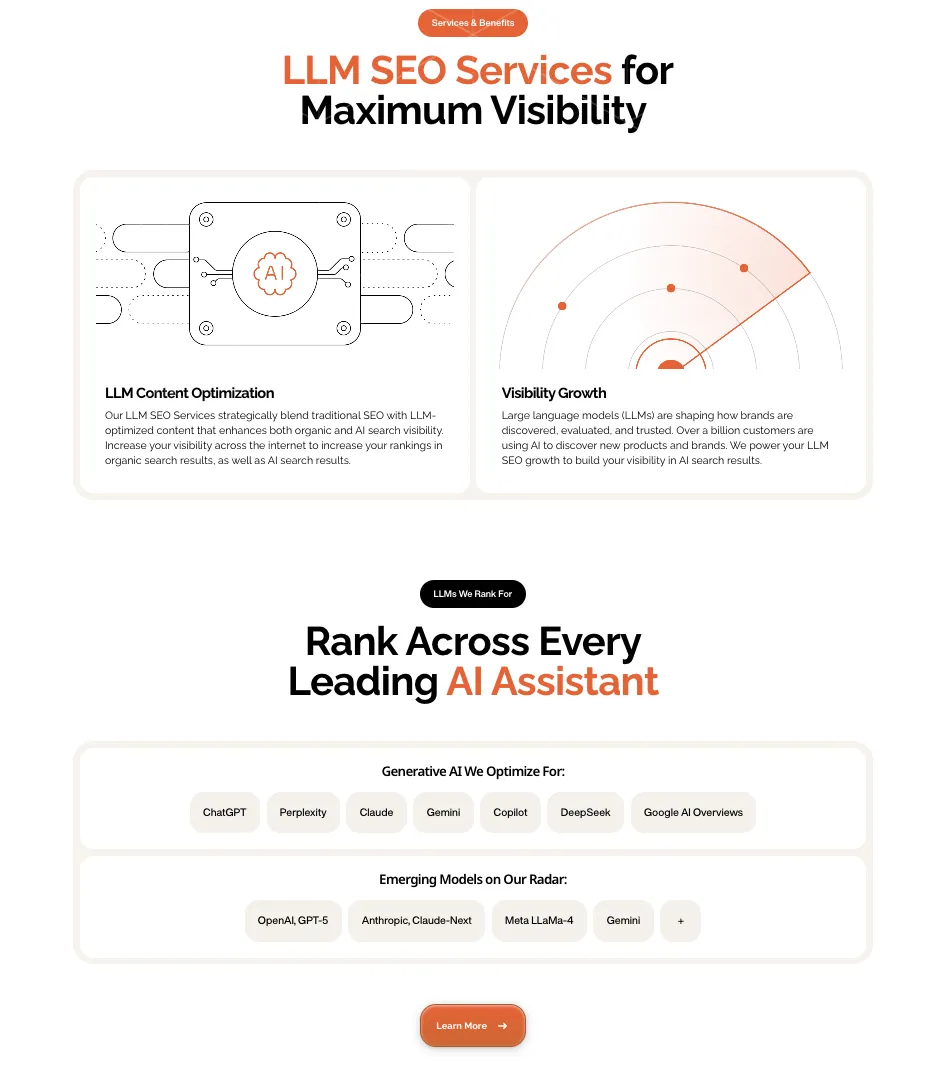
Semantic SEO moves beyond single keywords to focus on user intent, entities, and context. Map the questions your audience asks, define entities consistently, and craft content that answers those needs. When your content matches intent and context, it performs better in conversational and generative search results. This approach is particularly effective when applied in verticals such as iGaming affiliate SEO, where nuanced user journeys and entity relationships drive engagement.
Start by creating semantic clusters for core topics and their related questions, then tag pages and components with consistent entity names and relations. Use internal linking to show hierarchical relationships and help AI understand topical depth. Over time this approach builds a clearer site-level graph that generative systems can interpret more reliably. For more detailed guidance on aligning marketing with buyer behavior, consider the insights from our llm-modeling-for-buyer-influence resource.
Answer Engine Optimization (AEO)
AEO designs content to return concise, accurate answers. Use FAQ schema, conversational long-tail keywords, and clear Q&A sections so AI and search features can surface your content as direct responses or featured snippets. The goal is to be the best short, factual answer for a given query.
When constructing answer blocks, lead with the concise answer, then provide a brief explanation and a short example or use case. Keep answers factual, sourceable, and easily extractable by machines. Use consistent markup patterns for Q&A and consider providing micro-summaries for complex topics to improve the odds of being surfaced in generative responses. For an in-depth guide, check out our the-aeo-playbook-2026-answer-engine-optimization-strategies-for-igaming-and-high-competition-brands.
Monitoring and Measurement
Measure visibility and performance to know what’s working. Track appearance frequency, AI referrals, engagement metrics, and competitive mentions. Use those signals to prioritize updates, tune content, and prove ROI for AI-focused SEO work.
Combine behavioral signals (time on page, scroll depth) with AI-specific visibility metrics from search consoles or API reports. Set up dashboards that correlate content changes with shifts in AI-driven referrals so you can test hypotheses quickly. Regularly review low-engagement pages to identify gaps in intent matching or answer clarity.
Content Creation
Create content that answers buyer questions with a clear, conversational voice and evidence-backed claims. Combine human insight with AI assistance: use data, examples, and case studies to support your points while keeping the copy readable and focused on outcomes.
Adopt a hybrid workflow: humans draft outlines and review AI drafts for accuracy, tone, and relevance. Maintain version control and edit passes focused on E-E-A-T, factual verification, and semantic clarity. For repeatable formats like product pages or how-tos, build templates that embed schema and standardize entity references.
AI tools can speed content production and reduce costs, but quality control and editorial oversight remain essential.
AI-Powered Content Creation for SEO Optimization
This research looks at an AI-driven web app that automates content creation using OpenAI’s ChatGPT. The platform addresses rising demand for scalable, SEO-friendly content by cutting time and cost. Features include topic categorization, customizable prompts, multiple output formats (Word, PDF, Markdown), and direct WordPress publishing.
Optimizing Content Production Cycles with AI Technology
Continuous Optimization
SEO in an AI era is continual. Refresh content to reflect new user intent, test variations, and rework underperforming pages. Use LLM-based modeling to spot gaps and iterate quickly so your content stays relevant and authoritative. Services focusing on new market launch SEO particularly benefit from these nimble, data-driven update cycles to gain traction in competitive landscapes. For those transitioning from traditional approaches, our seo-to-ai-centric-optimization guide offers strategic frameworks to support this evolution.
Create a cadence for content reviews that includes intent audits, entity checks, and schema validation. Prioritize pages with strategic intent or high traffic for faster cycles, and maintain an evergreen schedule for core resources. Small, frequent edits often outperform large infrequent rewrites because they keep signals fresh for AI systems and human readers alike.
What is LLM SEO and How Does It Enhance AI-Driven Search Ranking?
LLM SEO applies large language models to understand and optimize content signals that matter to AI-driven search. LLMs surface patterns and semantic relationships that inform better content structure, phrasing, and entity usage — improving relevance and the likelihood of higher placements.
Practically, this means using model-driven analysis to identify common phrasings, question variations, and entity co-occurrences. Feed those insights into editorial guidelines and schema markup. The result is content that reads naturally to humans while delivering clear, consistent signals that LLMs can use when generating answers or ranking documents.
Defining Large Language Model Marketing and Its Role in SEO
Large Language Model marketing means shaping content and metadata so AI systems recommend your pages. It emphasizes semantic relevance, consistent entity signals, and brand authority so search platforms reliably interpret and surface your content. This is a key strategy for verticals focusing on B2B gaming SEO, where authoritative, consistent messaging drives strong platform recognition and trust.
Marketers should align messaging across metadata, body copy, and structured data so entity references match site-level knowledge. Consistency reduces ambiguity for AI systems and helps build a coherent brand presence in knowledge graphs and answer surfaces. Periodic audits of metadata and schema help catch drift as content scales.
How AI Content Optimization Improves Search Visibility
Optimizing AI content improves visibility by organizing information, answering queries directly, and tracking AI-specific visibility metrics. Clear structure and focused answers help search systems index and rank your content for relevant queries.
Effective optimization includes pruning redundant content, consolidating thin pages into authoritative resources, and enriching answers with clear examples or next steps. Where appropriate, add internal links that signal topical relationships and help AI understand which pages are canonical for a concept.
Which Semantic SEO Strategies Drive Effective AI-Powered Content Optimization?
Core strategies include structured content design, entity optimization, and AEO. Map the buyer journey, align topics to intent, and build content that answers real user prompts to boost semantic relevance and performance.
Use editorial calendars that prioritize semantic clusters and ensure coverage at each funnel stage. Monitor which cluster edges (related questions or subtopics) are underdeveloped and fill those gaps with concise, well-marked content to create a cohesive topical footprint.
Implementing Semantic Keyword Research Techniques for AI SEO
Semantic keyword research maps phrases and concepts across the buyer journey. Build semantic clusters, prioritize intent-driven terms, and craft content that reflects the language your audience uses when they’re ready to act.
Leverage query variants and conversational phrasing found in chat logs, support tickets, or search console data to expand intent maps. Group synonyms and related entities into clusters and use those clusters to guide page-level and site-level content strategies that support generative responses.
Leveraging Entity-Based SEO to Boost Search Relevance
Entity-based SEO centers on clearly defined concepts — people, places, products, and ideas — and linking them across your content and data. A consistent entity strategy improves machine understanding and helps search engines surface more relevant results.
Document canonical entity names and attributes in a simple internal ontology and ensure those values appear consistently in titles, meta descriptions, schema, and body copy. Where relevant, connect entities to authoritative external references, but avoid unnecessary linking that can confuse entity resolution.
How to Use Machine Learning SEO Tools for AI-Driven Search Optimization?
Machine learning tools help automate schema markup, suggest content improvements, and surface performance trends. Use them to scale routine tasks and to free editorial teams for higher-value work like strategy and quality control.
Adopt tools that integrate into your content workflow and produce actionable, prioritized recommendations rather than raw data. Ensure human review remains in the loop so that suggested edits preserve brand voice, factual accuracy, and compliance with your editorial standards.
Top Machine Learning Tools for Enhancing LLM SEO

Common classes of ML-powered SEO tools include:
- Schema Markup Tools: Simplify adding structured data so search systems better understand your content’s intent.
- Content Optimization Tools: Evaluate relevance, suggest improvements, and align copy with user intent and semantic signals.
- Monitoring Dashboards: Track visibility, referrals, and engagement so you can make data-driven adjustments.
When evaluating tools, prioritize those that match your CMS and support automated deployment of validated schema. Automation reduces developer overhead and helps maintain consistency across large sites while still allowing manual overrides for edge cases.
Integrating Natural Language Processing in SEO Workflows
NLP enriches SEO workflows by surfacing intent, extracting entities, and helping teams create content that matches how people search. Embed NLP insights into research, writing, and measurement to strengthen your semantic signals.
Use NLP to extract common question forms, detect sentiment, and identify entity co-occurrence patterns that indicate useful internal links or cluster groupings. Feed NLP output into briefs and templates so writers can produce content that aligns with modeled user language.
What Are the Best Practices for Structured Data and Schema Implementation in AI SEO?
Use relevant schema types, keep markup accurate and up to date, and pair structured data with clear content structure. High-quality content plus correct schema helps search systems index and present your pages more effectively. For example, implementations in sportsbook SEO applications often focus on dynamic data fields and event-specific schema to enhance AI comprehension.
Validate schema with testing tools and include it in your QA checklist for content launches. Maintain a small library of reusable schema snippets for common page templates so implementation is consistent and easier to audit over time.
Applying Schema.org Markup to Improve AI Search Comprehension
Choose schema types that match your content (articles, FAQs, products, etc.) and implement them cleanly. Proper markup clarifies intent for AI systems and can increase the chance of rich results.
Document the expected fields for each schema type used on your site to avoid incomplete implementation. For dynamic content, ensure server-side or CMS-driven generation of schema so it stays synchronized with page content and reduces the risk of stale or mismatched data.
Emerging tools aim to automate schema generation using semantic tech, which could simplify structuring web data at scale.
AI & Semantic Tech for SEO: Autonomous Schema Markups
Advances in AI and semantic technology are enabling search engines to better handle complex queries by identifying concepts and relationships on web pages. But unstructured fragments and inconsistent markup make entity identification difficult. Ontologies can structure web data, yet adding them often requires extra resources. This research proposes an autonomous method to detect entities in short, unstructured text fragments to support scalable schema markup.
Autonomous schema markups based on intelligent computing for search engine optimization, BUD Abbasi, 2022
Frequently Asked Questions
What are the benefits of using AI in SEO strategies?
AI improves SEO by speeding analysis, uncovering patterns, and personalizing content at scale. It helps with keyword discovery, trend identification, and automating repetitive tasks so teams can focus on strategy and creativity. The result is better alignment with user intent and more efficient content production.
AI can also surface obscure but valuable query variations and suggest structural changes that reduce friction in conversion flows. When used responsibly, it augments human expertise and allows teams to test more ideas with lower manual cost.
How can businesses measure the effectiveness of their AI-driven SEO efforts?
Measure AI-driven SEO with KPIs like organic traffic, engagement, conversion rates, visibility in AI features, and AI referral counts. Use analytics platforms and SEO monitoring tools to track trends and run experiments that show which tactics move the needle.
Complement quantitative metrics with qualitative checks such as content audits and user testing to ensure that AI-driven lifts reflect real user value rather than transient ranking artifacts. Tie experiments to business outcomes to maintain strategic clarity.
What role does user intent play in semantic SEO?
User intent is the foundation of semantic SEO. When content answers the question behind a query — not just matches keywords — it delivers value. Use NLP and intent mapping to create content that closely aligns with what users are trying to achieve.
Differentiate informational, navigational, and transactional intents and tailor content accordingly: concise answers for informational queries, clear paths for navigational needs, and persuasive detail for transactional intent. Intent alignment reduces bounce and improves conversion potential.
How does structured data impact AI-driven search results?
Structured data gives search systems explicit context about your content, which helps with indexing and surfacing richer results. Proper schema increases the odds of appearing in featured snippets, knowledge panels, and other AI-curated placements.
Structured data also aids internal tooling and content reuse by exposing semantic fields that editors and developers can consume. Treat schema as both a search optimization and an internal data standard for consistent content handling.
What are some common challenges businesses face when implementing LLM SEO?
Challenges include keeping up with rapid algorithm changes, maintaining content quality, and integrating AI tools without losing editorial control. Technical barriers like correct schema implementation and aligning teams around semantic strategies are common. Continuous learning and testing help overcome these hurdles.
Address these challenges with cross-functional workflows, shared taxonomies, and a lightweight governance process that balances speed with quality. Start small with pilot projects and scale practices that demonstrate measurable impact.
How can businesses stay updated on the latest trends in AI SEO?
Stay current by following trusted industry blogs, attending webinars and conferences, subscribing to specialist newsletters, and participating in SEO communities. Regular experimentation and monitoring of your own data will also surface trends relevant to your audience.
Establish internal channels for sharing learnings from experiments and vendor briefings so team knowledge stays current. Encourage time for continuous learning as part of performance goals to make trend tracking actionable rather than passive.
How Do Case Studies and Industry Trends Validate LLM SEO Marketing Solutions?
Case studies and industry trends show what works in practice and provide benchmarks for results. They demonstrate how strategies translate into visibility, engagement, and business outcomes when executed well.
When reviewing case studies, look for comparable contexts and repeatable tactics: content formats that consistently perform, schema implementations that yield better visibility, and optimization cadences that sustain improvements. Use these patterns to design experiments that fit your scale and resources.
Recent 2025-2026 Statistics on AI SEO Effectiveness
Recent data shows increased adoption of semantic SEO and measurable impacts of AI on search behavior. Tracking these trends helps teams prioritize tactics that align with shifting user expectations.
Translate observed trends into internal hypotheses and run controlled tests to validate whether the patterns hold for your audience. Use incremental rollouts so you capture learnings without risking core traffic or conversions.
Analyzing Successful LLM SEO Campaigns and Their Impact
Examining successful campaigns reveals repeatable patterns: clear intent mapping, strong entity signals, quality content, and ongoing optimization. These lessons inform future efforts and help scale what works.
Collect examples of page templates, schema snippets, and linking structures used in successful campaigns. Convert those artifacts into reusable assets so teams can apply proven formats quickly across new topics and maintain consistency at scale.
What Are the Technical SEO Considerations for Optimizing AI-Driven Search?
Technical priorities include crawlability, fast performance, and accurate structured data. Addressing these areas ensures search systems can access, understand, and serve your content effectively.
Audit logs and crawl reports regularly to identify indexing issues, and prioritize fixes that unblock high-value content. Ensure that dynamic rendering or client-side frameworks expose the same content and schema to crawlers as to users to avoid indexing discrepancies.
Optimizing Site Architecture for Semantic Search Engines
Design your site to surface authoritative content clusters, use clear navigation and internal linking, and apply structured data consistently. Good architecture supports semantic discovery and easier indexing.
Model your site as a topical graph where hub pages connect to cluster pages and canonical resources. This reduces ambiguity for AI agents and helps search systems infer topic intent and page relationships more reliably.
Monitoring and Measuring AI SEO Performance with KPIs
Track visibility metrics, engagement rates, authority signals, and AI referral sources. Use these KPIs to validate hypotheses, prioritize updates, and demonstrate impact to stakeholders.
Create alerting for sudden drops in AI referrals or visibility so you can investigate quickly. Combine competitive intelligence with your own metrics to spot opportunities where content gaps in your niche can be filled to capture attention.
How to Develop a Comprehensive Content Strategy for LLM SEO Marketing?
Build a strategy that maps buyer prompts, targets entities, and leverages structured data. Focus on topical clusters and content that answers real user questions across the funnel.
Use a layered approach: foundational cornerstone content, supporting cluster pages, and tactical pages for specific intents. Maintain a backlog of gap content derived from search data and customer interactions to keep the pipeline aligned with demand.
Creating Topical Clusters Around Generative AI and Semantic SEO
Create clusters that group related concepts, link authoritatively between pages, and scale content around core themes. This approach signals topical depth and improves semantic relevance.
Document cluster entry criteria and linking patterns so teams can onboard new topics consistently. Regularly reassess clusters for overlap and merge or split them based on performance and changing user language.
Using Visuals and Structured Data to Enhance Content Engagement
Combine informative visuals with accurate schema to make content easier to consume and more attractive to AI features. Visuals can improve engagement and increase the likelihood of being featured in rich results.
Optimize image alt text and captions to include clear entity references and concise descriptions of the visual. For charts or infographics, provide a short text summary and include underlying data points in machine-readable form where appropriate.
What Are the Future Trends and Continuous Monitoring Practices in AI SEO?
Future trends include deeper integration of generative AI in search interfaces and more automated schema tools. Continuous monitoring, experiment-driven updates, and flexible content workflows will be essential to keep pace.
Build lightweight experiment frameworks and keep a catalog of tests and outcomes. Over time, this catalog becomes a knowledge base that accelerates decision-making and reduces repeated experimentation on similar questions.
Tracking Semantic Changes and SERP Evolution for LLM SEO
Monitor AI mentions, use custom UTMs for experiments, and keep an eye on SERP changes. Continuous observation helps you adapt content and technical signals as search evolves.
Integrate SERP snapshots into routine reviews so you can detect gradual shifts in answer formats or entity prominence. This historical view helps you decide when to update summaries, restructure pages, or add clarifying schema.
Utilizing Industry Feeds and Entity Tracking Tools for Updates
Use industry feeds, knowledge graph updates, and entity-tracking tools (like Google Alerts and specialized monitoring services) to stay informed and update content when entity relevance shifts.
Create a lightweight process for reviewing entity changes and updating canonical pages. Assign owners for high-value entities so updates are implemented quickly and consistently across related content assets.
Conclusion
LLM SEO gives brands a practical way to improve visibility in AI-driven search by combining structured content, semantic strategies, and continuous optimization. Focus on user intent, clear entity signals, and E-E-A-T to build content that both AI systems and humans trust. Want to elevate your content strategy? Discover how our iGaming solutions can help you get there.
Start with small pilots, measure results carefully, and scale practices that show durable impact. With consistent workflows, validated tools, and a focus on user value, teams can leverage LLM SEO to deliver better experiences and sustainable visibility in an evolving search landscape.
For more insights on specific AI SEO strategies, check our detailed guides like how-to-rank-in-chatgpt-gemini-perplexity and explore targeted approaches in generative-engine-optimization-geo-the-igaming-seo-strategy-for-ai-powered-search.