Gambling Site SEO for Search and Answer Engines

By Nicole Diena Dobernig, Data Insight AI iGaming SEO Agency
Search technology keeps changing, and gambling site SEO has to keep pace with it.
This guide walks through an AI-native approach to optimizing gambling websites, covering the pieces that matter most for search visibility right now.
You'll find practical techniques for improving how your gambling site performs, how it engages players, and how it holds its ground in a crowded market.
Players increasingly turn to search engines to find gambling content, so a strong SEO strategy isn't optional anymore.
We'll walk through AI-centric optimization, semantic SEO, and E-E-A-T principles, along with the other pieces gambling sites need to show up clearly for both search engines and AI answer platforms.
Understanding how generative search systems weigh and display source credibility is key to keeping a strong digital footprint as AI reshapes search.
Building Digital Expert Authority in a Generative AI Search Environment Generative search is reshaping how web sources gain visibility and credibility within AI-driven digital ecosystems. Unlike traditional search engines that present web pages, generative search systems provide direct responses and cite selected sources, posing new challenges for optimizing online content, recognizing it, and establishing its reliability. Methodology for Establishing Digital Expert Authority of Web Resources in a Generative Search Environment, 2026
Key Takeaways
- AI-native SEO for gambling sites now hinges on Generative Engine Optimization (GEO) and Answer Engine Optimization (AEO) — structuring content so AI systems can confidently cite and surface it as a trusted source.
- Semantic SEO and entity-based authority architecture matter more than keyword density: content needs to demonstrate real topical authority across games, betting options, and regulations.
- E-E-A-T (Experience, Expertise, Authoritativeness, Trustworthiness) carries extra weight in gambling SEO because credibility and compliance transparency directly influence both user trust and search rankings.
- LLM citation mechanics reward structured markup, high-authority signals, current data, and transparent compliance documentation — all of which increase the odds of being cited in AI-generated answers.
- Technical SEO fundamentals (Core Web Vitals, schema markup, crawlability) remain the backbone that lets search engines and AI systems actually access and understand gambling site content.
- Sustained results depend on data-driven execution, continuous learning, content personalization, and a disciplined link-authority strategy working together over time.
Generative Engine Optimization (GEO) for Gambling Sites
Generative Engine Optimization (GEO) is emerging as a critical strategy for online gambling and sportsbook websites, addressing the transformation of search engines into AI-powered answer generators. GEO involves tailoring content and technical SEO elements to maximize visibility and authority in systems that synthesize and generate direct answers from diverse sources.
For gambling sites, GEO strategies emphasize building deeply interconnected content entities that align with typical user intents seen in generative queries. This means not only providing accurate information about games, betting options, and regulations but also structuring that content so generative AI can confidently cite it as a trusted source.
Key to GEO is the integration of entity-based authority architecture, which helps search engines and answer engines recognize the site as an authoritative hub of gambling knowledge. By consistently publishing detailed, semantically rich content that addresses varied aspects of wagering—from game rules to sportsbook odds analysis—sites strengthen their positioning as preferred sources for generative answer engines.
Additionally, GEO optimization involves continuous monitoring of generative search outputs to understand how AI interprets and surfaces content. This intelligence feeds back into content creation, ensuring alignment with evolving AI criteria and user expectations, which is especially crucial in a competitive and regulated sector like gambling.
AI-Centric Optimization

AI-centric optimization means putting AI technologies to work to make gambling websites more visible and more relevant in search results.
As machine learning has gotten better at reading user intent, SEO has moved away from keyword density and toward genuine content relevance.
AI can process huge volumes of data to shape content around what users actually expect, and that lifts both visibility and engagement.
In practice, gambling sites need to use AI to build concise content that answers user queries directly, not content stuffed with keywords.
Putting AI-driven strategies to work starts with understanding how search engines read data, then optimizing content around that.
Structured data is one of the most effective techniques here — it gives search engines better context about your content, which improves indexing and discoverability.
For gambling sites, that often translates into better positions in search results, stronger user engagement, and ultimately more conversions.
These AI-driven strategies also open the door for specialist agencies to guide gambling operators through the transition.
By folding data analysis and user feedback directly into campaign strategy, agencies can fine-tune their work for better outcomes.
Semantic SEO
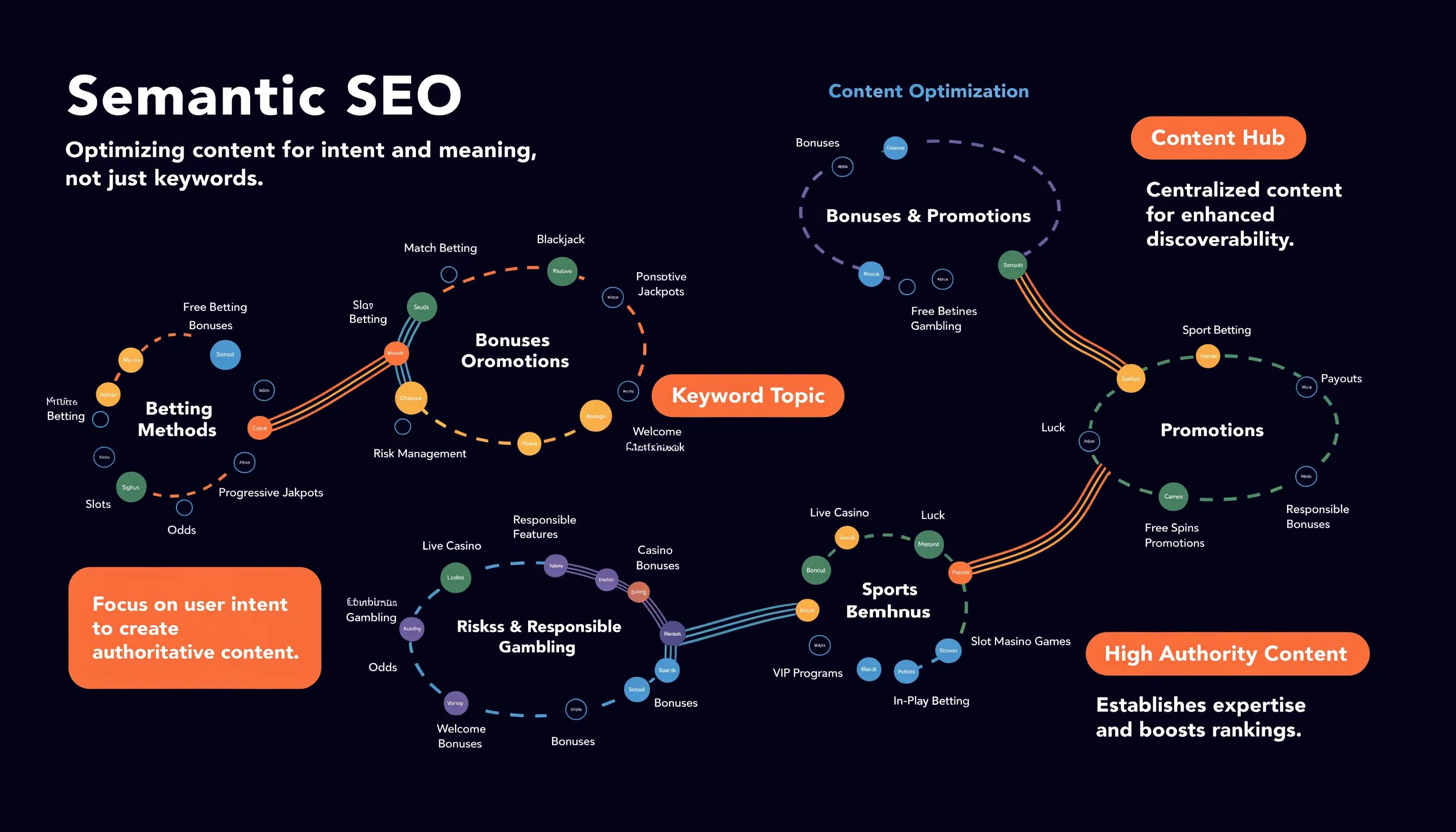
Semantic SEO has become central to modern optimization work, marking a shift away from chasing keywords and toward understanding what a search query actually means.
In gambling SEO, that means building content that shows real topical authority and matches what users are actually looking for.
When search engines understand meaning rather than just matching words, they deliver more relevant results — and users get a better experience.
Putting semantic SEO into practice means building structured content that covers related queries and synonyms, not just a single target phrase.
This helps sites rank for primary keywords while also picking up long-tail variations.
Topical clusters add another layer, strengthening a site's relevance and authority within the gambling niche and improving rankings overall.
For hands-on support with this, our iGaming SEO services can help.
Investing in semantic SEO pays off in organic traffic and user engagement, especially in a competitive market where getting the information right matters as much as ranking for it.
E-E-A-T Principles
E-E-A-T stands for Experience, Expertise, Authoritativeness, and Trustworthiness.
Strong E-E-A-T gambling content underpins successful SEO in this sector more than in most industries.
For gambling sites, credibility isn't optional — it's what earns user trust and moves search rankings.
Content that demonstrates real expertise shapes how both users and search engines view the site.
Building E-E-A-T starts with high-quality content from authors who actually know the field — insights from industry professionals, real statistics, and case studies that show a genuine command of the subject.
User reviews and testimonials add to this too, reinforcing the trust signals search engines look for.
Operational transparency — clear terms and conditions, for instance — adds further weight to a site's authority.
Gambling sites that hold to E-E-A-T principles build a stronger reputation and steadier, longer-lasting organic traffic.
Answer Engine Optimization (AEO)
Answer Engine Optimization (AEO) is about shaping content for AI-driven platforms that answer users directly rather than simply listing links.
As voice search and smart assistants grow, gambling sites need content built for featured snippets and quick answers — clear, concise responses to the questions people actually ask in this space.
AEO-ready content should use structured data wherever it applies.
That markup helps search engines pick out the key elements of a page, improving the odds of landing in an answer box or a voice search response.
An organized content strategy built around real user questions reinforces this further.
Done well, AEO doesn't just boost search visibility — it gives users fast, accurate answers, and that builds engagement and trust at the same time.
LLM Citation Mechanics and Impact on Online Gambling SEO
Large Language Models (LLMs) underpin generative AI systems that are rapidly reshaping search experiences. An important element in this transformation is how LLMs select, use, and attribute information from web sources through citation mechanics.
In the gambling and sportsbook sector, understanding and optimizing for LLM citation practices can make a significant difference in content visibility and credibility. LLMs generate answers by synthesizing data from multiple authoritative sites, and they include citations to bolster trust and verifiability in their responses.
Effective LLM citation optimization involves the following strategies:
- Structured and Clear Content Markup: Implement schema and other structured data to ensure AI understands the content context and can accurately attribute information.
- High Authority Source Signals: Build E-E-A-T principles extensively to encourage AI systems to select your site as a citation-worthy source.
- Consistent Content Updates: Keep data, terms, and regulations current, as LLMs prioritize recent and accurate information in dynamic sectors like gambling.
- Transparency and Compliance Documentation: Provide accessible certifications, licensing information, and operational transparency that AI models recognize as trust signals.
Aligning content creation and site architecture with LLM citation mechanics enhances the likelihood that your gambling site will be cited in AI-generated answers, boosting authority and driving organic traffic.
Technical SEO
Technical SEO for gambling sites is the backbone of any optimization strategy.
It's about how the site is built and how it performs.
A solid technical setup lets search engines crawl, index, and understand the content without friction.
Core Web Vitals matter here too, since they directly affect both rankings and how users experience the site.
Schema markup is a big part of this work.
It gives search engines context about what the content actually is, which helps users find relevant information faster.
For gambling sites, this matters even more, since services and offerings often need precise categorization to be understood correctly.
Technical SEO is never really finished — it's ongoing and reactive by nature.
Regular performance monitoring keeps a site ready to adapt as algorithms update and user behavior shifts.
Core Web Vitals: Key Metrics for Optimization
| Metric | Description | Ideal Value |
|---|---|---|
| Largest Contentful Paint | Measures loading performance | < 2.5 seconds |
| First Input Delay | Time it takes for the site to become interactive | < 100 milliseconds |
| Cumulative Layout Shift | Stability of the website's layout | < 0.1 |
Get these technical fundamentals right, and gambling sites don't just meet user expectations — they exceed them, driving stronger engagement and higher conversions.
Continuous Learning and Adaptation
Gambling site SEO moves fast, and long-term success depends on continuous learning and adaptation.
As algorithms evolve and user preferences shift, staying current on emerging trends and tools matters.
Pairing regular performance monitoring with user feedback lets teams adjust strategy proactively, before problems show up in the numbers.
Following SEO developments through industry news, webinars, and workshops benefits individuals and teams alike.
It also builds a culture of experimentation, which leads to data-driven decisions that genuinely move the needle on site performance and visibility.
A digitally literate team stays aligned on SEO best practices as a matter of course.
Adopting emerging technologies like AI tools and machine learning only sharpens the effectiveness of SEO strategy for gambling sites from there.
Entity-Based Authority Architecture
Entity-based authority architecture is about structuring information so it strengthens how a website is perceived by search engines and users alike.
The framework centers on defining entities clearly and connecting them in ways that demonstrate real topical relevance.
For gambling sites, that means clearly establishing entities like games, brands, and regulations within content — it helps users understand and stay engaged.
Knowledge graphs that visualize these relationships can noticeably improve both search visibility and overall site authority.
Building authority this way takes consistency — gambling sites need to keep publishing high-quality, relevant content that answers what their audience actually needs.
Over time, that steady output builds the site's reputation as a source people can rely on.
Data-Driven Execution
A data-driven approach is essential for executing SEO strategy on gambling sites.
Analyzing user behavior and engagement metrics helps teams spot where to improve and build campaigns around real gaps.
Predictive analytics goes a step further, flagging upcoming trends so content and marketing strategy can adjust ahead of time rather than after the fact.
Tools like Google Analytics, SEMrush, and Ahrefs supply the data behind decisions on keywords, engagement, and content performance.
Using them consistently helps set benchmarks and track whether ongoing SEO work is actually paying off.
Feeding data-driven insights back into SEO strategy improves results in the short term, and it builds a feedback loop that keeps the strategy adapting — which is what sustains success over time.
Content Personalization
Tailoring content to individual users can meaningfully lift engagement and conversion for gambling sites.
Personalization strategies typically draw on user demographics, preferences, and behavior data to shape customized content.
That targeted approach appeals to users directly, and it lines up well with search algorithms that favor relevant, user-focused content.
AI tools can automate much of this personalization, generating recommendations from user interactions and lifting overall satisfaction.
Continuing to optimize personalized content over time also surfaces deeper insight into what users actually prefer.
Investing in personalized content puts gambling sites in a better position to meet user needs — and that shows up in stronger retention and loyalty.
Link Authority and Trust Signals
Building domain authority through strategic link acquisition is another core piece of gambling site SEO.
A strong backlink profile signals credibility and trustworthiness to both search engines and users, and it directly influences rankings.
Relationships with reputable sites open doors for guest posting, partnerships, and reciprocal links.
Link quality beats link quantity every time.
The priority should be earning links from high-authority sites within the gambling industry, since those carry far more weight for domain authority.
Internal linking matters too — it should support the site's content structure, help users navigate, and reinforce semantic relevance.
Build link authority systematically, and gambling sites meaningfully improve their odds of ranking higher in search results.
What is AI SEO and how does it transform gambling site optimization?
AI SEO applies artificial intelligence to search engine optimization, and it's changing how gambling sites approach marketing strategy altogether.
It optimizes content for human readers and search algorithms at once, using machine learning to analyze data, predict trends, and streamline the work.
With AI tools, gambling sites can read user intent more accurately, working through large datasets to shape content that actually resonates with their audience.
That translates into better engagement and conversion, because users find content that matches what they're actually looking for.
AI's arrival in SEO is also pushing traditional SEO tools to evolve.
They now let marketers automate more of the process and hold a competitive edge in a market as saturated as gambling.
How do AI-powered tools and LLMO enhance iGaming SEO?
AI-powered tools and Language Learning Models Optimization (LLMO) push iGaming SEO forward by automating processes and keeping content relevant.
They work by analyzing large datasets, spotting patterns in user behavior, and turning those patterns into concrete recommendations.
AI tools sharpen keyword research, surfacing high-potential terms while reading the competitive landscape.
LLMO works differently — it optimizes content structure around natural language patterns, improving readability and engagement.
Together, AI and LLMO form a more cohesive strategy that handles the real intricacies of iGaming SEO.
AI-powered analytics tools also give iGaming operators a clear read on performance, so they can adjust strategy and keep improving website visibility over time.
Which benefits does AI bring to casino and sportsbook SEO strategies?
Bringing AI into casino and sportsbook SEO strategies delivers several notable benefits:
- Enhanced User Experience: AI-driven personalization tailors content to individual preferences, improving user satisfaction and retention.
- Increased Efficiency: Automation of keyword research and content optimization reduces the time and effort needed to develop effective SEO strategies.
- Improved Decision-Making: AI-powered analytics provide actionable insights, allowing operators to make data-driven decisions for content and marketing strategies.
Together, these advantages put gambling sites in a stronger position to capture market share through sharper user engagement and more targeted strategy.
How to implement effective iGaming SEO strategies for organic traffic growth?
To create a successful iGaming SEO strategy, operators should prioritize the following key components:
- Targeted Keyword Research: Identifying both high-traffic and niche keywords relevant to the gambling audience ensures alignment with user intent.
- Technical SEO Optimization: Ensuring the site structure, loading speeds, and mobile responsiveness meet current standards will enhance overall user experience.
- Content Strategy Development: Creating high-quality, engaging, and informative content tailored to user interests will improve organic traffic and search ranking.
Get these foundational elements right, and you have a strong base for growing organic visibility in a genuinely competitive iGaming market.
What technical SEO innovations improve gambling site rankings?
Emerging technical SEO innovations play a significant role in improving the rankings of gambling sites:
- Core Web Vitals Compliance: Ensuring websites meet essential performance metrics enhances user experience, which search engines increasingly prioritize.
- Enhanced Site Crawlability: Implementing XML sitemaps and optimizing robots.txt files ensures search engines can efficiently index content.
- Structured Data Implementation: Utilizing schema markup to provide additional context about content boosts the site's ability to convey relevant information to search engines effectively.
Adopting these innovations matters for staying competitive as the digital landscape keeps shifting.
Which AI SEO workflows maximize content relevance and user intent?
To maximize content relevance and align with user intent, operators should incorporate the following AI SEO workflows:
- AI-Powered Keyword Research: Using AI algorithms to uncover trending keywords and content gaps allows for more strategic content planning.
- Behavior Tracking: Analyzing user interactions on the site helps to refine content strategies based on real-time feedback.
- Content Personalization Techniques: AI can deliver personalized content experiences based on user preferences, enhancing engagement and satisfaction.
Put these workflows to work, and you get a comprehensive SEO strategy that sharpens both content relevance and user outcomes.
Modern AI Search Strategies: The AISO Framework and Beyond
Search engines are turning into AI-powered answer engines, and gambling sites need forward-thinking strategies that keep pace with evolving algorithms and user expectations.
One of the clearest models for this shift is the AISO framework — Authority, Intent, Structure, and Optimization.
It offers a holistic approach to AI-native SEO: build authoritative content that directly answers specific user intents, structure it so AI systems can understand it, and optimize it for visibility within these new search paradigms.
AI is reshaping SEO strategy at its core, moving the focus away from keyword targeting and toward a deeper read on context, user behavior, and the semantic relationships between pieces of content.
That shift pushes gambling sites to prioritize content that demonstrably answers user questions and builds trust, rather than chasing isolated keyword rankings.
A good example is the AISO framework applied to a European gaming GEO strategy, where operators tailored content and SEO tactics to local gaming regulations, preferred products, and language nuances.
Using AI-driven analysis to pin down region-specific user intent, then structuring content around it, these sites gained more search prominence and stronger engagement in competitive local markets.
It's a clear case of AI-native frameworks paying off for regional SEO.
Bringing the AISO framework into play, along with the lessons from these regional applications, gives gambling sites a more precise way to navigate the complexities of modern AI search — and to hold on to relevance and competitive advantage over time.
Frequently Asked Questions
What makes gambling site SEO different from SEO in other industries?
Gambling site SEO carries a heavier compliance and trust burden than most sectors. Search engines and AI answer platforms weigh E-E-A-T signals more heavily here, so credibility, licensing transparency, and demonstrable expertise matter as much as technical optimization and keyword targeting.
How does AI-native SEO differ from traditional SEO for gambling websites?
Traditional SEO leans on keyword density and backlink volume. AI-native SEO shifts the focus to semantic relevance, structured data, and content that directly answers user intent, since AI systems read meaning and context rather than matching isolated keywords.
What role does Answer Engine Optimization play in gambling site visibility?
AEO shapes content so AI-driven platforms can extract clear, direct answers rather than just indexing a page. For gambling sites, that means structured data and concise, question-focused content built to surface in featured snippets and voice search responses.
Why does technical SEO matter as much as content for gambling sites?
Technical SEO controls whether search engines can crawl, index, and understand a gambling site at all. Core Web Vitals, schema markup, and site performance directly affect both rankings and user experience, so strong content alone isn't enough without a solid technical foundation.
How can gambling operators measure whether their SEO strategy is working?
Data-driven tools like Google Analytics, SEMrush, and Ahrefs track keyword performance, engagement, and conversion trends. Feeding that data back into strategy on an ongoing basis is what turns SEO into a measurable, improving system rather than a one-off effort.
For specialized sports gambling visibility, explore our dedicated sports betting SEO services.