Large Language Model SEO Strategies for iGaming

By Nicole Diena Dobernig the founder of Data Insight AI iGaming SEO Agency · Updated 2026-09-02
AI-based iGaming SEO solutions combine retrieval optimization, schema and entity grounding, and semantic authority mapping to earn citations across ChatGPT, Gemini, Perplexity, and Google AI Overviews.
Data Insight, an AI-native SEO agency, applies these methods for regulated online casinos, sportsbooks, and affiliate networks, building structured, answer-ready content that AI systems trust, retrieve, and recommend.
Key Takeaways
- Data Insight AI iGaming SEO Agency operates from Roma, Italy with 1 dedicated employee.
- AI-based iGaming SEO services deliver data-driven strategies targeting improved SERP positions and organic ROI.
- Proven SEO solutions address online casinos, sports betting platforms, poker sites, and slots competitively.
- Full-service iGaming agencies combine website analysis, competitor research, and custom optimization for predictable growth.
What Does AI-Based iGaming SEO Actually Solve?
AI-based iGaming SEO closes the gap between ranking and being cited.
Traditional optimization chases blue-link positions.
large language model SEO strategies for iGaming target something bigger: visibility inside ChatGPT, Gemini, and Perplexity answers.
Operators get named, understood, and recommended rather than simply listed.
The stakes are steep.
Online casinos, sportsbooks, and poker platforms compete in one of the most crowded, tightly regulated corners of the internet.
Regulatory scrutiny limits what a brand can say, while competitor density drives up the cost of every keyword.
Millions of players search for casino games and betting platforms every day, and a brand missing from the first page, or the first AI-generated answer, loses those deposits to a rival that got there first.
Why isn't ranking on Google enough anymore?
Search behavior has shifted toward answer engines that summarize, cite, and recommend brands directly.
A casino operator ranked page one on Google can still be invisible inside an AI Overview or a Perplexity response if its content lacks the structure those systems retrieve from.
What specific problems does this approach fix?
- Discovery gaps: brands absent from AI-generated summaries lose qualified traffic before a click ever happens
- Regulatory friction: compliant content structures satisfy both search engines and jurisdiction-specific advertising rules
- Attention migration: featured snippets and Answer Engine Optimization capture demand shifting away from traditional rankings
Data Insight builds for this shift, putting iGaming brands in position for LLM-driven discovery so search visibility turns into first-time deposits instead of lost traffic.

What Do You Need Before Starting AI SEO?
Four assets determine readiness: a compliant technical foundation, a partner fluent in regulated markets, a lean expert team, and clear entity signals search engines can trust.
Missing any one of these delays retrieval and citation results by months.
Large Language Model SEO strategies for iGaming only work once these foundations exist.
Operators competing in licensed markets need a partner grounded in EU compliance realities, not generic marketing theory.
Data Insight works out of Rome, Italy, and puts regulated European casino and sportsbook brands in front of a team that understands EU gambling regulation firsthand.
That location matters more than it might seem: compliance nuance shapes everything from content claims to structured data markup.
Team structure matters too.
Data Insight runs lean, built around a single core operator rather than a sprawling generalist agency.
Fewer hands mean fewer handoffs and tighter accountability across every engagement.
Does agency experience actually matter for AI search readiness?
Experience shapes how fast AI systems learn to trust a domain.
Data Insight's engineers bring more than 10 years of dedicated iGaming experience, layered on nearly two decades in search and demand generation.
That depth translates into faster entity recognition and fewer costly missteps during optimization.
Before any AI-focused work begins, brands need the following in place:
- Establish full-spectrum SEO foundations engineered specifically for regulated casino and sportsbook operators.
- Confirm technical architecture supports structured data and clean crawlability.
- Verify entity signals (brand name, licensing, location) are consistent across the web.
- Partner with a team that understands both search mechanics and gambling compliance.
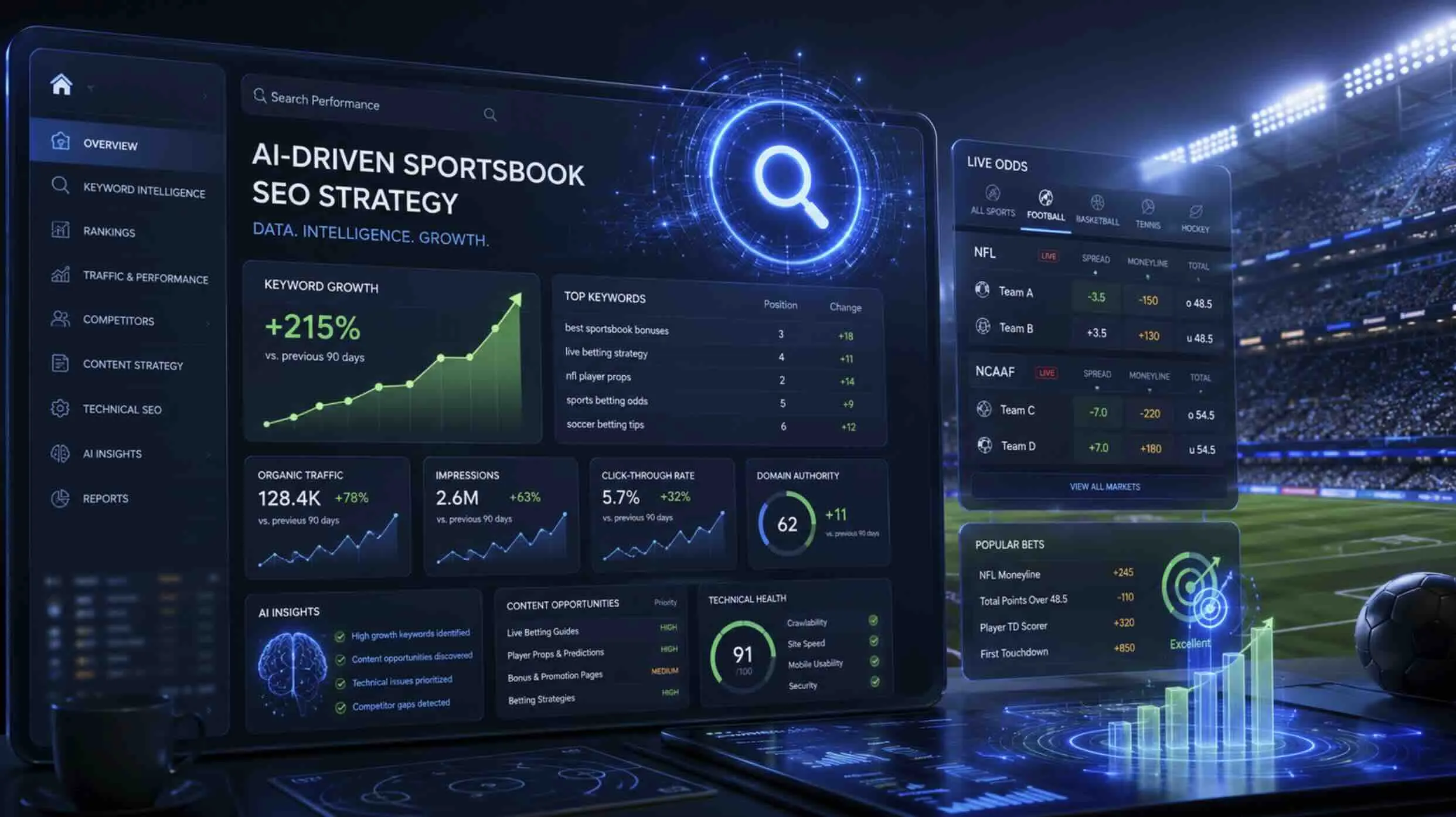
How Do You Audit AI Search Visibility First?
Auditing AI search visibility starts with a full technical inventory: crawl architecture, Core Web Vitals, structured data, and site speed all feed the algorithmic edge that follows.
Skip this step and operators lose real pipeline.
Organic revenue for gambling sites stays unpredictable when regulatory and jurisdictional challenges complicate regional and global market entry, and casino and sportsbook brands that scale content spend before auditing these signals often burn budget chasing rankings that never convert into first-time deposits.
A proper audit doesn't stop at technical checks.
It benchmarks the site against direct competitors, then maps gaps against Large Language Model SEO strategies for iGaming that connect visibility to revenue outcomes.
Effective audits analyze the website and rival platforms side by side to identify where growth in first-time deposits and registered users stalls.
What Should an iGaming AI Visibility Audit Include?
An audit should score four layers: technical health, competitive positioning, citation readiness across answer engines, and content structure.
Each layer needs its own baseline before optimization begins, since fixing content structure without technical stability rarely holds gains.
Executives running this process should follow a defined sequence:
- Inventory technical infrastructure: audit crawl paths, Core Web Vitals scores, structured data coverage, and page speed across casino, sportsbook, and affiliate templates.
- Benchmark competitors: analyze rival domains entering the same regional and global markets to expose gap opportunities.
- Score AI citation readiness: test how ChatGPT, Gemini, Perplexity, and AI Overviews retrieve and reference the brand's content.
- Align findings to KPIs: tie every technical and content gap to first-time deposit and registered-user growth targets, not rankings alone.
Why Tie the Audit to Revenue KPIs?
Rankings alone mean nothing without conversion.
Custom growth systems align AEO, GEO, technical SEO, content, and backlink strategy to revenue KPIs, turning raw visibility into measurable pipeline that finance teams can track quarter over quarter.
How Do You Build Semantic Authority and Entity Clarity?
Semantic authority comes from proving to search engines and AI models that a brand's identity, licensing, and offerings connect consistently across the web.
Entity clarity depends on structured data, disambiguation, and knowledge graph presence rather than keyword density alone.
Operators that treat these as separate tasks miss most of the gain.
Building both follows a defined sequence:
- Audit existing entity signals across the operator's website, third-party databases, and knowledge panels.
- Map every product, license, and brand variant into a structured knowledge graph.
- Disambiguate the operator's entity from similarly named competitors and affiliate sites.
- Apply schema markup and technical architecture that grounds each claim in verifiable data.
- Track citation frequency across generative engines and refine the structure every quarter.
A regulated European sportsbook and casino operator followed this sequence and recorded a notable increase in generative engine AI citations across a multi-quarter optimization program, one of several proven Large Language Model SEO Strategies for iGaming now driving measurable answer-engine visibility.
Knowledge graph integration, semantic authority mapping, and entity disambiguation powered that gain, not content volume.
Results compound as technical grounding scales further.
An enterprise casino operator reached a notably strong AI visibility score during an LLMO implementation cycle spanning ChatGPT, Perplexity, Gemini, and Google AI Overviews.
Retrieval optimization, schema and entity grounding, and structured technical SEO architecture made that score possible.
What Counts as an Entity Signal in iGaming SEO?
Entity signals include consistent brand data, licensing details, game catalogs, and verified knowledge panel information.
Search engines and language models cross-reference these signals to confirm which brand a query refers to.
Weak or conflicting signals push AI systems toward citing competitors instead.
Why Does Entity Disambiguation Matter for Gambling Affiliates?
Affiliate networks often share similar names, domains, or brand structures across regulated markets.
Disambiguation separates one operator's entity from lookalike competitors inside the knowledge graph.
Without it, citation credit and AI recommendations drift toward the wrong brand entirely.
How Do You Optimize Technical Architecture for Retrieval?
Retrieval-ready technical architecture unifies crawl efficiency, indexation control, and AI-citation readiness into one framework.
Specialist search optimization built for the competitive iGaming landscape treats these three layers as interdependent, not separate projects.
Casino and sportsbook platforms that isolate crawl budget from schema strategy leave gaps that language models exploit as reasons to skip a page entirely.
Building this architecture follows a defined sequence:
- Audit crawl budget allocation across the domain, flagging low-value URLs that drain resources from priority pages.
- Restructure site architecture and facet navigation so bonus filters, game categories, and odds pages resolve into clean, indexable paths.
- Expand the topical map (a domain knowledge network) to connect entity clusters like game types, betting markets, and jurisdictions through deliberate internal linking.
- Monitor crawl logs continuously to confirm search bots and AI crawlers reach priority content before secondary pages.
An iGaming affiliate portal that applied this sequence recorded a notable expansion in organic search traffic.
That growth traced directly to architectural restructuring, facet navigation management, topical map expansion, and disciplined crawl budget optimization working together, not in isolation.
Does Regulatory Compliance Affect Technical SEO Architecture?
Yes.
Operators licensed across multiple jurisdictions need architecture that withstands regulatory scrutiny in every market simultaneously, not just the primary one.
Geo-targeted URL structures, jurisdiction-specific schema, and compliant internal linking patterns keep licensed pages distinct while preserving crawl efficiency site-wide.
Affiliates face a different pressure: aggressive content volume paired with link strategies strong enough to compete against entrenched incumbents.
In both cases, technical architecture is what determines whether large language model SEO strategies for iGaming brands can surface the right pages for citation at all.
How Do You Structure Content for Answer Engines?
Answer-ready structure requires a direct response in the opening sentence, followed by supporting evidence and context.
Search engine optimization for regulated gambling sites has always meant ranking higher in results pages.
Answer engines demand a stricter format: the answer comes first, the explanation follows.
Executives building Large Language Model SEO strategies for iGaming need to treat every page section as a standalone citation unit, not a chapter in a longer narrative.
Casino reviews, game guides, and betting tutorials perform best when each section opens with a compliance-aware, data-driven answer before expanding into detail.
This structure serves two audiences at once: players scanning for fast answers, and AI systems extracting passages for citation.
Content built only to rank in traditional blue links misses the retrieval layer entirely.
What Format Do AI Systems Prefer When Citing iGaming Content?
AI engines favor short, self-contained paragraphs with a clear subject-verb-object structure.
Bullet lists, comparison tables, and numbered steps get extracted more reliably than dense narrative blocks.
Practical steps for structuring an iGaming page include:
- State the direct answer in the first sentence of each section.
- Support the claim with a specific fact, statistic, or regulatory detail.
- Format comparisons, bonus terms, or game rules as tables or lists.
- Close each section with a transition that signals the next logical question.
Why Does Structure Matter More Than Keyword Density Now?
Attention has shifted away from ranking lists toward generative answers, featured snippets, and AI Overviews.
Optimizing purely for keyword frequency ignores where search behavior is actually moving.
Pages built for extraction (clear headings, tight paragraphs, verifiable facts) earn citations that keyword-stuffed pages never reach, regardless of their position on a traditional results page.
How Do You Measure AI Citation Performance?
AI citation performance gets measured through visibility scoring, traffic verification, and timeline benchmarking against industry growth.
A brand either shows up when ChatGPT, Perplexity, Gemini, and Google AI Overviews answer a gambling-related query, or it doesn't.
One iGaming operator reached a notably strong AI visibility score during an LLMO implementation cycle, proving that retrieval rates can be tracked with the same rigor as keyword rankings.
Marketing executives running Large Language Model SEO strategies for iGaming should follow a structured measurement sequence:
- Establish a baseline score. Audit current retrieval rates across major answer engines before any optimization work begins.
- Track citation frequency over time. Log how often the brand's name, odds data, or bonus terms appear inside generated answers.
- Verify traffic correlation. Cross-reference visibility gains against organic search performance; one affiliate portal recorded a notable organic traffic expansion after architectural restructuring, confirming that AI-facing changes moved real numbers.
- Benchmark against market growth. The iGaming sector is projected to reach 281.3 million users by 2029, so brands measuring citation performance early build compounding advantage before competitors catch up.
What Counts as a Strong AI Visibility Score?
Scores near or above the notably strong mark reached in documented LLMO cycles signal that a brand's entities, schema, and content structure are fully machine-readable.
Lower scores usually point to weak entity grounding or thin structured data, not a lack of content volume.
Does Traffic Growth Confirm AI Citation Success?
Traffic growth confirms that visibility improvements translate into visitors, not just theoretical retrieval.
The notable organic increase recorded for one affiliate portal demonstrates that citation gains and traffic gains move together when architecture, navigation, and topical coverage are optimized in tandem.
What Mistakes Undermine iGaming AI SEO Campaigns?
Four errors consistently derail AI search performance for casino and sportsbook brands.
Duplicate white-label content, weak entity signals, poor internal linking, and unchecked affiliate over-dependence top the list of failure points that keep operators invisible to answer engines.
Each mistake compounds the others and erodes the semantic authority that Large Language Model SEO strategies for iGaming are designed to build.
Why does duplicate content kill AI visibility?
White-label platforms often ship identical casino and sportsbook copy across dozens of skins.
Large language models struggle to determine which domain deserves citation credit when the underlying content is indistinguishable.
None of the competing brands gets recommended reliably.
What role does regulatory compliance play in AI SEO failures?
Affiliates who overlook regulatory scrutiny across multiple licensed markets end up chasing the same head terms as every rival in the vertical.
That approach produces crowded, undifferentiated content that AI systems have no reason to single out.
Operators expanding into new regions face a related trap: organic revenue stays unpredictable long after launch when regional market-entry challenges go unaddressed.
Growth teams that skip jurisdiction-specific planning inherit volatility instead of compounding visibility.
Compliance failures carry a second cost.
Campaigns that bypass regulated-market compliance checks undercut whatever visibility gains they achieve.
AI systems and search engines both weight trust signals tied to licensing and jurisdictional legitimacy.
A compliant technical and content framework protects standing over time rather than exposing the brand to takedowns or deindexing.
Common mistake patterns include:
- Content duplication across white-label skins with no unique entity signal
- Thin internal linking that fails to connect product pages to authority content
- Affiliate over-dependence without a parallel owned-content strategy
- Regulatory blind spots during multi-market expansion
- Compliance shortcuts that trade short-term rankings for long-term deindexing risk
Executives who audit these five areas first typically uncover the fastest path to recoverable AI citations.
FAQ
What is AI-based iGaming SEO?
It combines retrieval optimization, schema and entity grounding, and semantic authority mapping to earn citations across ChatGPT, Gemini, Perplexity, and Google AI Overviews for regulated casinos and sportsbooks.
Where is Data Insight AI iGaming SEO Agency located?
Data Insight AI iGaming SEO Agency operates from Roma, Italy, with a team grounded in EU gambling regulation and compliance realities affecting content and structured data.
How big is the Data Insight team?
Data Insight runs lean, built around a single core operator, a structure that keeps the agency focused and accountable as an AI-native SEO partner for regulated iGaming brands.
Conclusion
AI-based iGaming SEO solutions have become an operational necessity for regulated gambling brands competing in post-Google discovery environments.
The shift from ranking visibility to retrieval optimization, semantic authority, and citation readiness demands specialized expertise that traditional SEO cannot deliver.
Brands that align their technical architecture, content strategy, and entity signals with AI system requirements build sustainable organic growth independent of paid acquisition costs and affiliate dependency.
FAQ
What is AI-based iGaming SEO?
It combines retrieval optimization, schema and entity grounding, and semantic authority mapping to earn citations across ChatGPT, Gemini, Perplexity, and Google AI Overviews for regulated casinos and sportsbooks.
What is query fan-out, and why does it matter for iGaming AI SEO?
Query fan-out is how large language models handle a single search: instead of matching one page to one question, the model splits the query into several related sub-questions and pulls a separate passage to answer each one before assembling a final response.
For a casino or sportsbook brand, that means a single page on bonus terms, licensing, or game rules needs to hold multiple self-contained, answer-ready sections: one covering eligibility, another payout mechanics, another jurisdictional rules, so the model has a citable passage ready for every branch of the fan-out instead of skipping the page because it only satisfies part of the question.
Where is Data Insight AI iGaming SEO Agency located?
Data Insight AI iGaming SEO Agency operates from Roma, Italy, with a team grounded in EU gambling regulation and compliance realities affecting content and structured data.
How big is the Data Insight team?
Data Insight runs lean, built around a single core operator, a structure that keeps the agency focused and accountable as an AI-native SEO partner for regulated iGaming brands.